
As RF power densities continue to increase, thermal management has become one of the most critical challenges facing next-generation GaN-based devices. Excessive channel temperatures can reduce efficiency, accelerate degradation mechanisms, and ultimately limit device lifetime. While GaN-on-SiC has long been the industry standard for high-power RF applications, emerging GaN-on-AlN architectures offer a compelling path toward improved thermal performance and enhanced reliability.
One often overlooked contributor to device heating is the thermal boundary resistance (TBR) that exists at material interfaces. In conventional GaN-on-SiC structures, heat generated in the active GaN channel must cross the GaN/SiC interface before reaching the substrate. Because GaN and SiC possess different phonon spectra, heat-carrying phonons are partially reflected or scattered at the interface, creating a thermal bottleneck that impedes efficient heat flow.
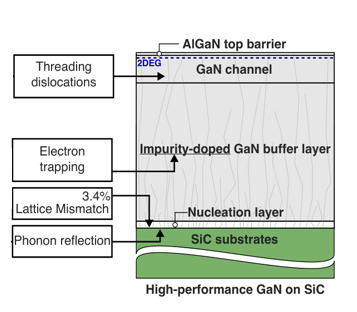
Recent thermal characterization studies have demonstrated that GaN-on-AlN structures can achieve significantly higher thermal boundary conductance than GaN-on-SiC. Since both GaN and AlN are III-nitride materials with more closely matched phonon properties, phonon transmission across the interface is more efficient, reducing thermal resistance and improving heat extraction from the device channel.
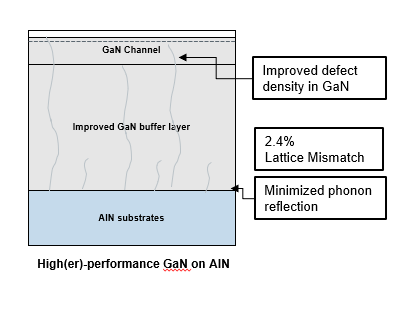
The advantages extend beyond interface physics. Bulk AlN substrates combine excellent intrinsic thermal conductivity with the ability to support thin, high-quality pseudomorphic GaN channel layers. Unlike many conventional GaN-on-SiC device structures that require relatively thick buffer layers to manage lattice and thermal expansion mismatches, GaN-on-AlN architectures can often utilize thinner transition layers. This shortens the thermal transport path between the active region and the heat-spreading substrate, further reducing thermal resistance.
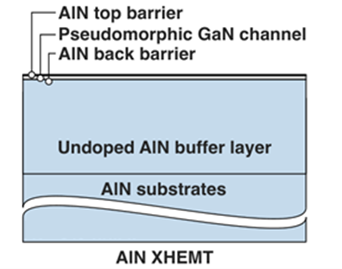
Recent studies have quantified these benefits. Walwil et al. measured enhanced thermal boundary conductance in GaN/AlN heterostructures compared with conventional GaN/SiC systems, highlighting the importance of improved phonon spectral matching. Song et al. demonstrated that AlN/GaN/AlN transistor structures on bulk AlN exhibit lower channel temperatures through suppression of phonon-boundary scattering and more efficient heat removal. Similarly, Chen et al. reported successful growth of high-quality GaN directly on single-crystal AlN substrates, along with thermal characterization results that support the promise of GaN-on-AlN for high performance RF devices.
The combination of high thermal conductivity, superior interface conductance, reduced buffer requirements, and shorter heat-flow paths enables significantly lower channel temperatures compared with traditional GaN-on-SiC architectures. Lower operating temperatures can improve reliability, reduce performance drift, and support higher power densities.
As RF systems continue to push the limits of power and efficiency, substrate engineering will play an increasingly important role and bulk AlN is becoming an attractive foundation for future devices. GaN-on-AlN technology represents a promising approach to overcoming thermal limitations and enabling the next generation of reliable, high-performance RF electronics.
Additional Reading:
Husam Walwil, et al; Thermophysical property measurement of GaN/SiC, GaN/AlN, and AlN/SiC epitaxial wafers using multi-frequency/spot-size time-domain thermoreflectance. J. Appl. Phys. 7 March 2025; 137 (9): 095105. https://doi.org/10.1063/5.0245381
Yiwen Song, et al.; Enhanced thermal performance of AlN/GaN/AlN XHEMTs on bulk AlN by suppression of phonon-boundary scattering. Appl. Phys. Lett. 8 December 2025; 127 (23): 233505. https://doi.org/10.1063/5.0305053
Y H Chen, et al.; Direct growth of high-quality GaN on single-crystal AlN substrate and related thermal characterization[J]. J. Semicond., 2026, 47(6): 062502 https://doi.org/10.1088/1674-4926/25120047
E. Kim, Y.-H. Chen, N. Pieczulewski, et al. “ XHEMTs on Ultrawide Bandgap Single-Crystal AlN Substrates.” Adv. Electron. Mater. 12, no. 3 (2026): e00393. https://doi.org/10.1002/aelm.202500393